How Much Money Are Missed Calls Costing Your Roofing Company?
Most Roofers Guess at This Number. You Don't Have To.
Ask a roofing business owner how much money they lose to missed calls and you'll usually get a shrug, or a guess pulled out of thin air. That's not because the number doesn't matter. It's because nobody's ever sat down and actually done the math on their own business.
Here's how to do it in about five minutes, with numbers you already know.
The Math
You need three numbers, and you probably already have a rough idea of each one:
- Your average job value. Not your biggest job, not your smallest. The number a typical completed job actually lands on.
- How many calls you miss in a normal week. Crew on a roof, office closed, three calls stacking up during a busy stretch. Be honest here. Most owners underestimate this until they actually track it for a week.
- What percentage of missed calls would have turned into a job. Not every call is a real lead, but a lot of them are. A reasonable estimate for most roofing companies is somewhere between 20 and 40 percent.
Multiply it out: missed calls per week times your close rate times your average job value, then times 52 for the year.
A concrete example: if your average job is $10,000, you miss 4 calls a week, and a third of those would have become jobs, that's roughly 1.3 lost jobs a month. At $10,000 a job, that's over $150,000 a year walking out the door before you ever got a chance to quote it.
Your numbers will look different. That's the point. Run your own.
Why This Happens More Than Owners Realize
A roofing business isn't set up to have someone sitting by a phone all day, and it shouldn't be. Your team is on roofs and in trucks, which is exactly where they need to be. The problem is that the phone doesn't know that. It rings whether or not anyone's free to answer it.
Storm season makes the math worse in both directions. Call volume spikes right when your crews are busiest, so the miss rate goes up at the exact moment the average lead value (storm damage, insurance claims) is often higher too.
What Actually Closes the Gap
The fix isn't hiring a full-time receptionist for a problem that mostly happens outside normal hours and during unpredictable spikes. That's expensive and it still leaves gaps on nights, weekends, and the moments when three calls come in at once.
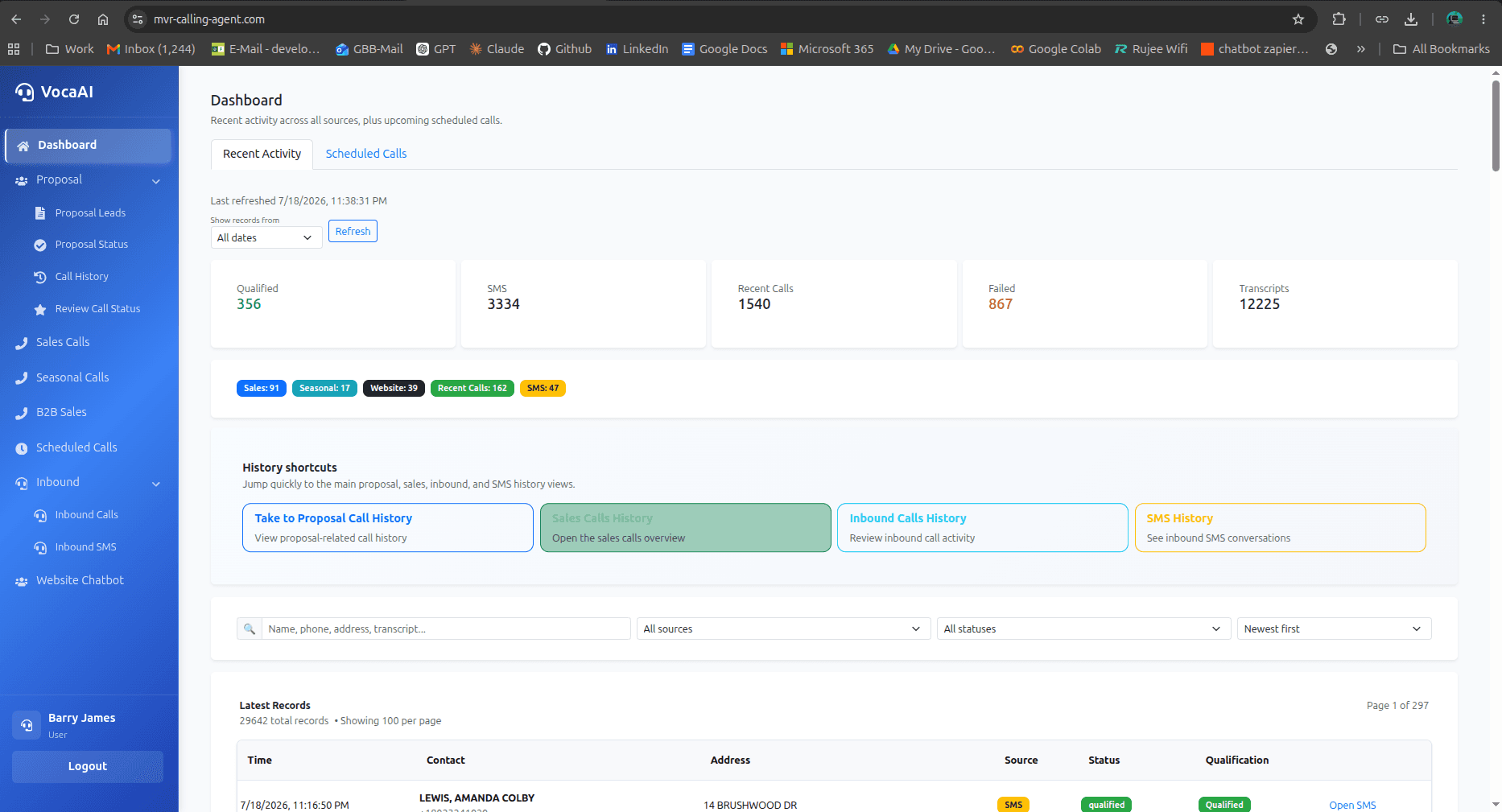
What actually closes the gap is something that can answer every call at the same time, qualify the job on the spot, and get the details to your team immediately, without needing a shift schedule. That's the entire premise behind the AI calling agent for roofing companies I build and manage for clients: it's built specifically to catch the calls a roofing business structurally can't staff for.
Run Your Own Numbers
If you want a second pair of eyes on the math for your specific business, book a free missed-call audit. I'll ask a few questions about your call volume and job value, and give you an honest read on whether this is worth solving right now or not.
Have a similar problem to solve?
I build production AI systems like this one — calling agents, chatbots, and automation — for real businesses. Tell me what you're trying to build and I'll tell you honestly if it's a fit.